(Word count ~24700 characters, whitepaper-style industry news for independent site SEO | Structure: Introduction → Product Overview → Trend 1: Diverging Demands Between Home and Commercial Fitness Segments → Trend 2: Independent Multi-Station Layout as Core Competitive Edge for Premium Gym Equipment → Legacy vs New-Generation Multi Gym Solution Comparison → Pain Points Facing Commercial Gym Operators → Forward-Looking Industry Forecast → Conclusion)
1. Introduction
The global commercial strength fitness equipment market continues reshaping its product roadmap, as boutique fitness studios and mid-sized commercial gyms confront rising rental costs, limited usable floor space, and growing member expectations for diversified, low-wait training experiences. Single-function isolator machines, once standard fill-in options for gym layouts, are increasingly challenged by integrated multi-station selectorized systems that maximise training density within a fixed footprint. Operators no longer prioritise sheer equipment quantity; instead, they evaluate return on floor space, equipment durability, customisation flexibility, and member throughput as core procurement KPIs.
Within this shifting landscape, Shandong DongLi Health And Technology Co.,Ltd introduces the FOUX Four Station Multi Gym with Pivoting Arm, a heavy-duty selectorised multi-gym engineered exclusively for high-frequency commercial gym and fitness studio deployment. Built around independent station architecture, modular expansion capability, and customisable visual and functional configurations, this unit responds directly to the dominant market trend of compact high-capacity strength zones. This article breaks down the underlying industry trends, benchmarks the new machine against legacy multi-gym formats, analyses persistent operator pain points, and forecasts the evolving direction of multi-station strength apparatus over the coming years.
Shandong DongLi Health And Technology Co.,Ltd, established in 2021 in Dezhou, China, is a high-tech manufacturer specialising in fitness equipment R&D, design and production. Covering a 15,000-square-meter factory, we have an in-house R&D team to support full-cycle production from concept design to finished goods. Our product range covers multi-function racks, treadmills and multi-station gym machines, serving home gyms, commercial fitness centers and corporate fitness facilities. Adhering to “Design-driven, Quality-centered”, we hold multiple design patents and trademarks. With stable quality and dependable after-sales service, our fitness gear gains wide recognition from global partners. We pursue integrity, innovation and win-win cooperation to deliver premium fitness products and solutions worldwide.
2. Product Overview: FOUX Four Station Multi Gym with Pivoting Arm
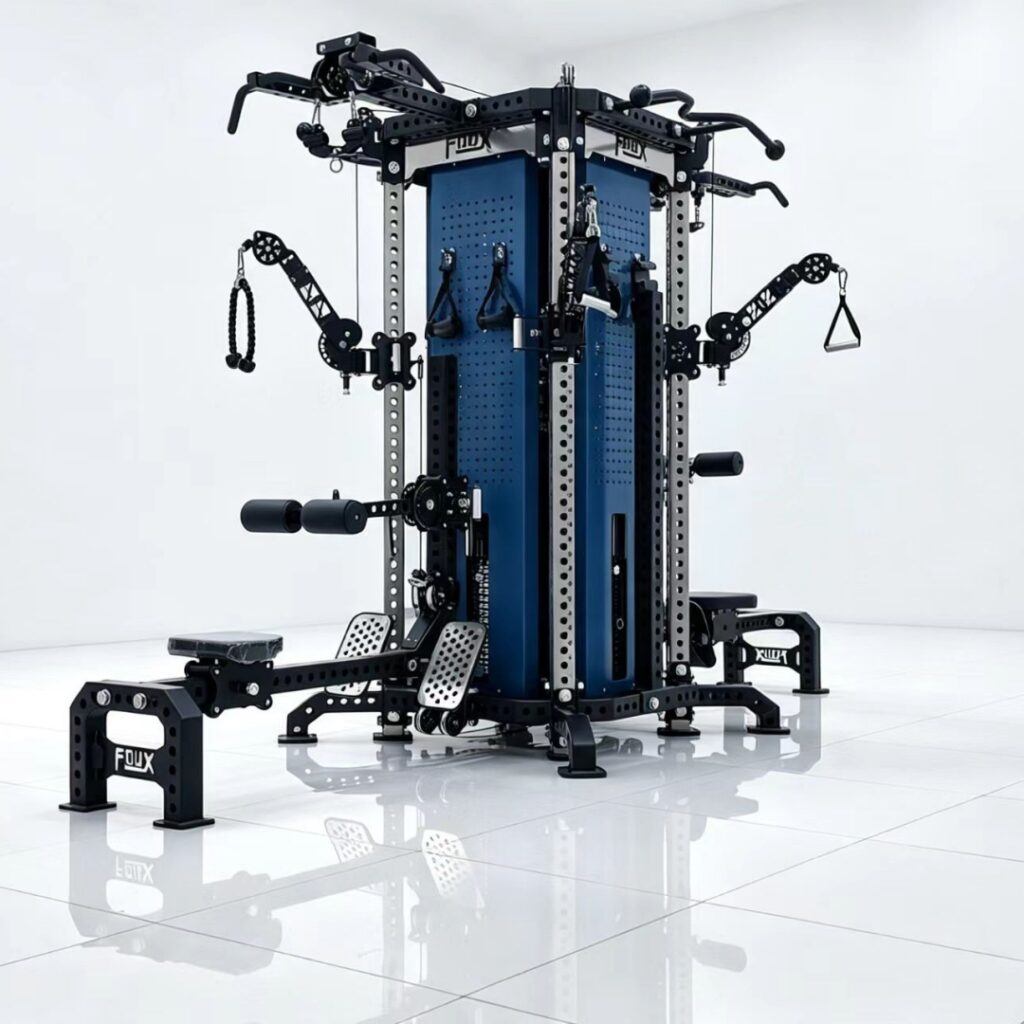
The FOUX Four Station Multi Gym with Pivoting Arm is a four-station pin-loaded strength trainer built for continuous daily commercial operation. The machine adopts a heavy frame specification of 75*75mm tubing with 3mm wall thickness. Customers may select upgrade adjustment posts manufactured from either 201 or 304 stainless steel, both supplied at a 3.5mm wall thickness for smooth movement, corrosion resistance and long-term deformation prevention. Its load-bearing cable is a 5mm diameter cable coated with 95# TPU material, rated at a breaking load of 9.68KN, approximately 987kg. The complete frame undergoes internal and external double powder coating treatment to minimise rust formation under humid, high-usage gym environments.
Four fully independent training stations are integrated into one unified chassis. Each station carries an individual 80kg weight stack, enabling up to four users to train simultaneously without cross-interference. Every single station supports independent weight adjustment, fine angle tuning and handle replacement, adapting to varied body types and fitness proficiency levels while following ergonomic movement paths to accurately target intended muscle groups.
The signature pivoting mechanical arm unlocks multi-angle chest fly movement to stimulate upper, mid and lower pectoral muscles. Beyond chest training, the machine supports a broad library of training modalities: cardio-focused rowing to build cardiovascular endurance, isolated leg strength work, pull-up and lat pulldown back training, plus bicep and tricep shaping routines for complete full-body strength programming.
Modular expansion architecture is embedded into the core design. Reserved expansion ports accommodate a wide range of optional attachments including lateral raise modules, ski trainer units and additional functional accessories, allowing owners to extend training functions targeting fat loss, muscle hypertrophy and physique shaping. The thick welded reinforced frame maintains stable performance under heavy loading. Four-side guard panels are fitted across the chassis; these protective panels tidy the internal structure, elevate visual presentation, and support separate custom powder coating to match venue interior themes. Integrated accessory storage organizes accessories and keeps gym floors tidy. Functional customisation is available for all four sides of the machine. The unit is backed by a 1-year manufacturer warranty and protected by multiple design patents.
3. Trend 1: Clear Demand Divergence Between Home and Commercial Fitness Segments
A defining macro trend separating the modern multi-gym market is the widening divergence between home-use and commercial-use product requirements. Home multi-gym buyers prioritise compact footprint, simple assembly, moderate load capacity and budget pricing. Their usage frequency is intermittent, with 1–2 users per unit and relatively low cumulative wear and tear. As a result, home multi-gyms often employ lighter gauge steel, simplified cable routing and limited adjustability.
Commercial buyers operate under entirely different constraints and priorities. For commercial gyms and fitness studios, equipment is a revenue-generating asset. Usage cycles are continuous, with back-to-back user rotation across opening hours. Operators prioritise three non-negotiable pillars: structural durability under repetitive heavy loading, independent station design to avoid user bottlenecks, and customisation potential to align equipment branding with studio identity. This split creates two distinct product lanes, and generic multi-gyms built for residential use cannot satisfy the rigorous standards of high-traffic commercial venues.
This segmentation explains why purpose-built commercial multi stations like the FOUX Four Station Multi Gym with Pivoting Arm occupy a growing niche. Manufacturers that continue selling lightly reinforced, shared-cable multi gyms struggle to retain commercial buyers, as these low-tier models degrade quickly and create constant waiting queues when multiple members attempt training at the same unit.
4. Trend 2: Independent Four-Station Architecture as Premium Equipment’s Core Competitive Advantage
Historically, many low-cost multi-gym platforms share one cable system or a single weight stack across multiple exercise points. This shared architecture creates a hard limitation: only one user can train on the whole machine at a time, regardless of how many exercise positions are built into the frame. These “pseudo multi-station” machines appear feature-rich on spec sheets but deliver poor member throughput, a critical weakness for commercial operators.
The new industry benchmark for premium multi-station selectorised strength equipment is fully independent station layout, where every training zone is equipped with its own dedicated weight stack, cable routing and adjustment system. This design permits parallel training by multiple users, directly lifting the gym’s member handling capacity without adding extra floor equipment. For boutique studios operating on tight square-meter budgets, this design delivers exceptional floor-space ROI.
Independent station architecture also improves user experience and operational safety. Each trainee controls their own resistance setting and movement angle, eliminating conflicts between users and reducing collision risks common on shared-cable multi gyms. Combined with pivoting arm mechanics for multi-planar chest work and modular accessory expansion, independent four-station units become flexible central strength hubs rather than static single-purpose machines. This is the core differentiator that positions the FOUX Four Station Multi Gym with Pivoting Arm against legacy shared-stack multi gyms.
5. Legacy Multi-Gym vs New-Generation Independent Four-Station Solution Comparison
Traditional shared-stack multi gyms are most often built with lighter, medium-gauge steel, and many only apply surface coating on a single side of the frame. They rely on one shared weight stack, meaning just a single user can train at any time, even if the frame includes several exercise positions. Their cables are usually basic coated options with limited tensile strength, movement paths are fixed, and there is almost no room to add extra training attachments. These standard models usually come with fixed finish colours, no separate customisation for protective panels, and lack dedicated storage spots for accessories. Without guard panels, pulleys and internal cables remain exposed, which slows down daily cleaning for gym staff. While this type of equipment may work for low-frequency, lightly used small studios, continuous heavy rotation quickly accelerates frame wear, cable fraying and structural instability.
In contrast, the FOUX Four Station Multi Gym with Pivoting Arm is engineered from the ground up for heavy commercial duty. Its main frame uses 75*75mm Q235 carbon steel tubing with a 3mm wall thickness, while adjustment posts can be upgraded to either 201 or 304 stainless steel with a 3.5mm wall thickness. Every one of its four stations carries its own separate 80kg weight stack to support four simultaneous users. It uses 5mm 95# TPU coated cable with a breaking load of 9.68KN, paired with internal and external double powder coating to defend against rust. The pivoting arm enables multi-angle chest training, and reserved expansion ports accept lateral raise, ski trainer and other functional attachments. The four-side guard panels not only cover internal components, but can also receive custom powder coating independently to match studio decor. Operators can tailor functions for all four sides of the machine. Supported by a 1-year warranty and protected by design patents, this unit is built to sustain long daily use in busy commercial fitness environments.
6. Persistent Pain Points Facing Commercial Gym and Studio Operators
Even with rising awareness of multi-station strength platforms, venue owners continue facing four interconnected pain points when sourcing selectorised strength machines.
First, floor space scarcity paired with high rent pressures. Urban gym locations command premium rental rates, so adding multiple single-function machines inflates capital expenditure and consumes valuable training space. Many operators cannot afford to line their strength zones with separate chest, back, leg and cable machines.
Second, equipment bottlenecks and poor member flow. Shared-stack multi gyms create queues, reduce member satisfaction, and lower how many clients a gym can serve per hour. Long waiting times drive churn in membership-based fitness businesses.
Third, inconsistent build quality and premature corrosion. Low-cost imported multi gyms often use thin tubing, single-side paint and basic cable assemblies. In gym environments with sweat humidity and constant contact, frames rust, cables fray, and weld points fail quickly, generating unplanned repair downtime and service costs.
Fourth, limited branding and customisation options. Many mass-produced strength machines ship in one or two standard colours with fixed function layouts. Boutique studios building unique brand aesthetics struggle to match equipment finishes to their interior design, and cannot adapt machine functions to their specific training programming focus.
The FOUX Four Station Multi Gym with Pivoting Arm directly targets each of these pain points: four independent stations maximise user density within one footprint, heavy-duty frame and double powder coating combat corrosion and fatigue failure, side guard colour customisation and four-sided function tuning give operators branding and programming flexibility, and modular expansion lets studios add functions gradually as their member base grows.
7. Future Forecast for Commercial Multi-Station Strength Equipment
Over the next three to five years, the market for commercial selectorised multi gyms will continue moving along four clear trajectories.
First, independent dedicated-station layouts will gradually displace shared-stack multi gyms as the preferred choice for serious commercial fitness venues. Buyers will increasingly filter product options by concurrent user capacity instead of simply counting exercise movement varieties listed on spec sheets. Floor ROI calculations will become standard during procurement reviews.
Second, material and surface finish standards will tighten. Operators will place higher value on corrosion-resistant construction, including stainless uptights and dual-sided powder coating, especially for coastal locations and high-humidity studios. Cable specifications, weld quality and load rating data will be scrutinised more closely by buyers and their equipment consultants.
Third, modularity and customisation will evolve from premium add-ons to baseline expectations. Gym owners will expect configurable function layouts, colour customisation on cosmetic panels, and expandable accessory interfaces, so one machine can adapt as programming evolves rather than becoming static hardware.
Fourth, the boundary between fixed selectorised training and functional cable training will blur. New multi-station platforms will integrate multi-angle pivoting arms and cable pathways that support both isolated hypertrophy work and dynamic conditioning movements, merging traditional bodybuilding training with modern functional fitness programming.
Manufacturers that only supply fixed, non-customisable shared-stack multi gyms will face compressed margins and shrinking commercial demand. Suppliers combining heavy-duty structural engineering, independent station architecture, and flexible customisation will capture the bulk of growth within this segment.
8. Conclusion
The global commercial fitness equipment market is undergoing a measurable shift away from low-throughput, shared-component multi gyms toward purpose-built independent four-station selectorised systems that reconcile limited floor area, high member demand, and brand customisation requirements. The FOUX Four Station Multi Gym with Pivoting Arm from Shandong DongLi Health And Technology Co.,Ltd aligns fully with these dominant market trends.
Its 75*75mm thick carbon steel frame, optional stainless adjustment posts, high-tensile TPU-coated cable, double internal-and-external powder coating, four independent 80kg weight stacks, pivoting mechanical arm for multi-angle chest training, modular expansion ports, customisable side guard colours and four-sided functional configuration address the core operational frustrations reported by gym and studio owners. Built for continuous high-frequency commercial deployment and backed by a 1-year warranty, the machine is protected by the company’s registered design patents.
For commercial gym operators, fitness studio planners, and global fitness equipment distributors, independent four-station multi gyms represent a high-value, space-efficient strength solution. As rental costs rise and member expectations continue to evolve, this category of equipment will remain one of the most impactful investments for venues aiming to raise training capacity without expanding their physical footprint.
Global gym owners and fitness distributors are welcome to contact Shandong DongLi Health And Technology Co.,Ltd for complete specification sheets, layout drawings and customisation consultation for the FOUX Four Station Multi Gym with Pivoting Arm.